The Fine Print Behind an ‘All-Inclusive’ AI Ads Price
A line-by-line teardown of a typical AI ads pricing card, from account limits and generation caps to spend tiers, setup work, and the human cost of acting on alerts.
September 25, 2026
•
min read



A $1,500-a-month PPC cockpit can tell you that your Google Ads account wasted money over the weekend. It cannot give you the money back.
I have watched growth leads and agency owners hunt for one platform to balance spend across Google, Meta, Microsoft, and retail networks on autopilot. They are spending $30,000 to $100,000 a month. Google Ads accounts for 75% or more of their revenue, while secondary channels nibble away at the rest of the budget with unpredictable returns. They search for real-time PPC optimization across multiple channels. What they often find is a cockpit that aggregates reports, shows pacing charts, and emails a suggestion that someone must still log in to review.
What the vendor deck calls “real-time multi-channel optimization,” I call an expensive alert system. Google’s auction-time bidding moves faster than an external rule on an hourly API sync. Meanwhile, useful signals remain trapped in separate channel reports. A high-performing Google search query does not automatically become a test on another network. Before buying a platform, decide whether you need another view of the work or a system that does it.
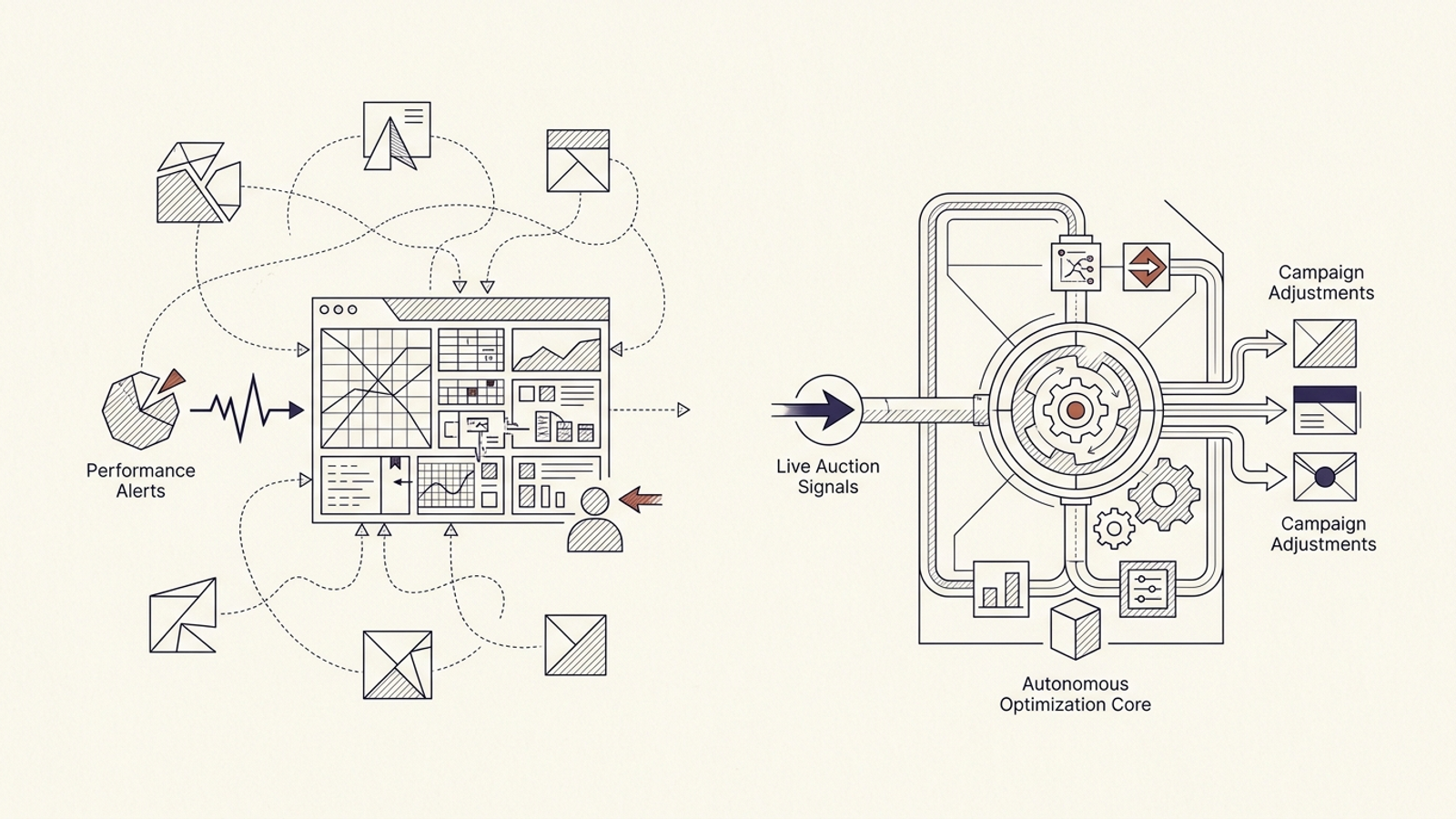
A dashboard that refreshes every four hours is not optimizing your campaigns. Real-time optimization means continuous monitoring and execution within the limits of the data available: moving budget, blocking wasted spend, and adjusting relevance when performance signals warrant it.
Most platforms sold under that banner are diagnostic. They show Campaign A at a $42 CPA and Campaign B at $78, then ask you to approve a transfer. If someone must check whether attribution is double-counting conversions and click “Apply,” the work still belongs to that person. The software has attached a toll to it.
There is a technical limit here that vendors tend to glide past. Google’s Smart Bidding evaluates bids at auction time using contextual signals, including query syntax, device, browser, location, and conversion likelihood. A third-party platform outside Google’s infrastructure cannot join that millisecond calculation. Ad network APIs introduce reporting lag, too: conversions may take between 3 and 15 hours to stabilize across data-driven attribution models, and offline conversion uploads can take hours to index.
So when an external vendor says it “bids across channels in real time,” ask what that means. Often, an API script runs on a timer. If it polls every four hours, a budget runaway could burn through $3,000 before the tool registers the CPA spike. No external engine can act on a conversion it has not received. It can, however, monitor available signals around the clock, catch intraday anomalies, cut spend that is visibly bleeding, adjust budget distribution, and suppress irrelevant search terms as they surface. That is the useful standard to test.

When 75% to 85% of your paid acquisition budget flows into Google, treating every channel as an equal bucket of clicks makes little sense. Google Search captures explicit commercial intent that secondary channels often have to approximate. On paid social networks such as Meta or LinkedIn, you interrupt people who fit an ideal customer profile. On YouTube or display, you may be buying brand recall. On Google Search, a prospect types the problem they need solved now. That query is one of the clearest economic signals in your acquisition mix.
For years, performance teams managed each platform as a separate kingdom: one buyer watched Google Search, another handled Meta, and a third checked Microsoft Ads. At month’s end, everyone hoped the blended CAC satisfied leadership. I have done enough spreadsheet work to respect the people keeping those accounts running. I have also seen how much useful information dies in the handoff.
That separation matters more when ad networks rely on machine-learning delivery. Google’s algorithms do not need someone nudging manual keyword bids all day. They need accurate conversion values, search-term guardrails, and responsive budgets. Secondary channels can benefit from what the core search account reveals, provided the team or system can translate that signal into an appropriate test rather than copy a Google campaign wholesale.
If a tool diverts money from high-margin search campaigns to chase cheaper clicks elsewhere, its blended chart may improve while your business gets worse. Keep the channel that produces the revenue at the center of the decision.
Most PPC software described as “cross-channel optimization” pulls Google Ads, Meta, and Microsoft data into one table, calculates a blended CPA, and colors the underperformers red. That is useful reporting. It is not the same as eliminating waste.
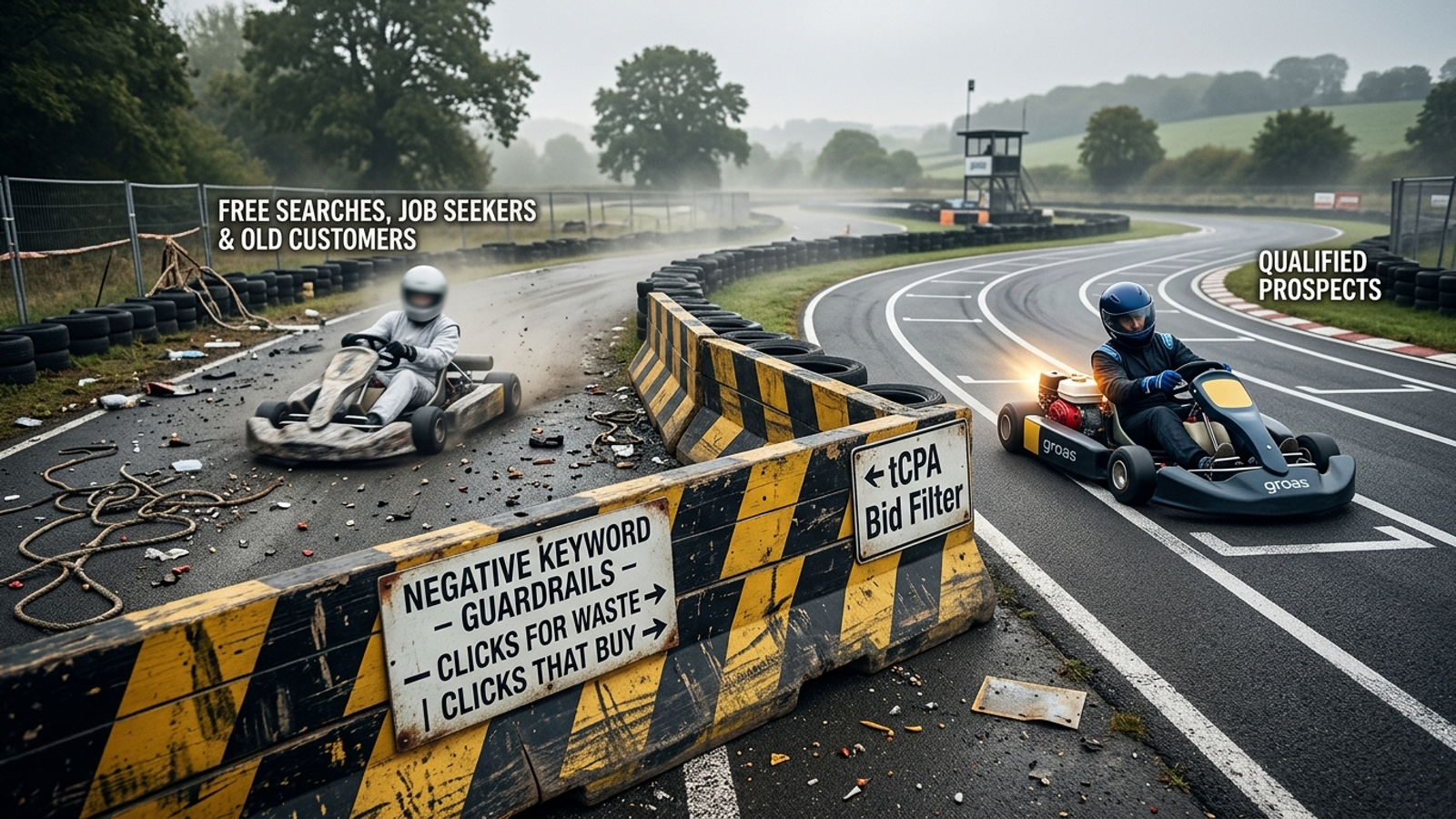
Suppose a search campaign spends $1,200 on irrelevant broad-match queries over a weekend. A Monday alert explains what happened, but the money is gone. The operational bottleneck behind manual optimization tools is the human step between seeing that metric and making a campaign change. A closed loop turns a signal into an action, then records what it did. Two parts of that loop matter most when Google is your core channel.
A Google Search campaign may uncover a surge in high-converting intent around a product use case or a competitor’s pricing change. In a manual setup, that discovery can sit in a search-term report for weeks. In an integrated framework, it can inform Microsoft Ads targeting, relevant negative-keyword decisions, and message-matched landing page tests for retargeting.
That does not mean a query should trigger an identical change everywhere. Search terms, audiences, and creative are different instruments. The point is to move the underlying commercial insight while there is still time to use it. When signals stay in channel silos, you pay to rediscover intent.
Intraday allocation is where manual management gets uncomfortable. Google’s daily budget system can let a campaign spend up to twice its average daily budget on a high-traffic day, balancing over the monthly billing cycle. Pull budget at 2pm because pacing looks fast, and you may choke off peak-hour conversions. Leave it alone, and low-intent traffic may exhaust the day’s room before dinner.
An autonomous system can recalculate distribution during the day against marginal returns and client-defined financial limits. Say Google reaches a diminishing-return threshold on a Tuesday afternoon while Microsoft Ads campaigns are converting at a 35% lower CPA. The engine should be able to shift available spend, not raid a campaign blindly or breach the monthly cap. Speed only helps when the system knows what it is allowed to spend and what a worthwhile conversion is.
Vendor demos tend to feature tidy accounts: two active campaigns, predictable traffic, no tracking surprises. Real accounts have conversion lag, broken tracking, seasonal spikes, and the occasional landing page change nobody mentioned. I would test a candidate platform against those conditions before giving it access to an ad account or a credit card.
Notice what is missing: executive-summary PDFs, sentiment scores, and proprietary “optimization scores” that echo an ad platform’s own recommendations. I have spent enough time managing accounts to distrust a score that improves when I open the budget tap on broad match. Give me an action log and firm boundaries instead: spend floors, spend ceilings, target CPAs, and negative exclusions. The test is whether the platform protects margins while taking mechanical work off your plate.
The industry likes to blur AI-assisted and autonomous. An AI assistant sits in the passenger seat calling out directions while you keep both hands on the wheel. It drafts ads for review, suggests bids for approval, and flags queries for someone to exclude. That may help an operator work faster. It does not remove the operator from the delivery loop.
For someone running multiple accounts, or a business spending $50,000 a month across Google Ads and secondary channels, that distinction is not semantic. You can still spend ten to fifteen hours a week confirming changes, interpreting graphs, and finding out whether a midday surge drained the budget before lunch. Call it a copilot if you like. You are still driving.
Autonomous execution takes on the repeatable work: budgets, search-query filtering, campaign adjustments, and ad relevance changes. The model behind groas pairs specialized machine-learning models running continuously with a named senior strategist who sets business direction, enforces financial guardrails, and remains accountable for revenue outcomes. The account records actions and their rationale, so you can inspect what happened without spending the day in a dashboard. Human judgment sets the destination and boundaries; the engine handles the repeated turns.
| Evaluation dimension | Legacy AI-assisted cockpit | Autonomous growth engine (groas) |
|---|---|---|
| Execution | Recommends changes for a person to review and apply | Executes campaign adjustments, exclusions, and budget shifts directly |
| Operating hours | Depends on a team returning to the dashboard | Runs continuously, 24/7 |
| Cross-channel signals | Combines charts; people carry insights between channels | Uses commercial and search-intent signals in ongoing execution |
| Human responsibility | Team or agency interprets data and completes the work | Named strategist sets guardrails and owns revenue outcomes |
| Pricing | Software subscription alongside an agency retainer or spend-based fee | Flat monthly fee with no setup fee or spend-based penalty |
If Google Ads generates most of your acquisition pipeline, stop paying for a prettier rear-view mirror. Periodic check-ins and weekly CSV exports can tell you what went wrong; they cannot consistently act while the opportunity is still there. Set the financial guardrails, connect campaigns to real revenue, and make the engine do the work.