TRANSCRIPT: Discovery call. Tuesday, 10:04 a.m. Duration: 27 minutes. Names omitted because I still have to work in this industry.
REP: Before we talk pricing, quick question. How visible is your brand across ChatGPT, Gemini, Perplexity and Google AI Overviews?
YOU: I do not know. That is why I took the call.
REP: Exactly. Most brands are invisible, and they do not even know it.
[TRANSLATION: He starts with a question you cannot answer, then offers to sell you the scoreboard. First you feel blind. Then you pay to see.]
Act 1: The demo shows 40 prompts you are losing
REP: I am sharing my screen. Can you see it? This is your AI visibility audit. We ran 40 high-intent prompts for your category. On 34, you did not appear. On the other six, a competitor was cited above you.
YOU: That looks bad.
REP: It is bad. Every day buyers ask ChatGPT what to buy, and your brand is not in the answer. There is no page two in AI. You are either cited or you are invisible.
[TRANSLATION: He asked chatbots about you, put the red X marks in a grid and called it an audit. The grid may be useful. It shows you a set of answers you should inspect. What it does not show is that paying him will change any of them. I used to present impression share reports as though finding a gap were the same thing as closing it. It was not.]
YOU: Okay. What do you change to get us cited?
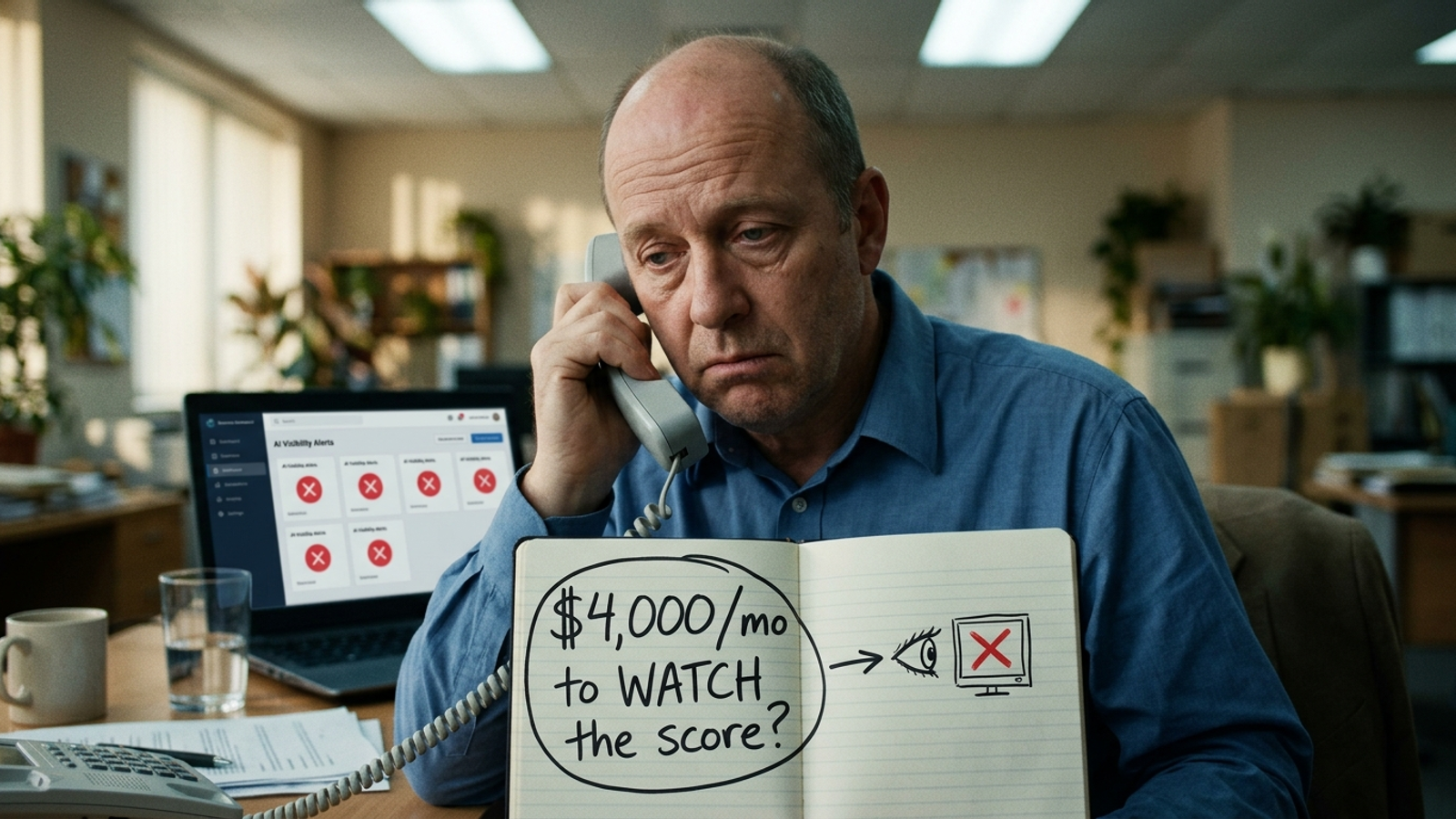
REP: Great question. Our platform tracks 500 buyer prompts across ChatGPT, Perplexity, Gemini and AI Overviews. You get a weekly visibility score, sentiment tracking, competitor gap analysis and an alert every time your share of voice moves.
YOU: That tells me where I stand. What moves the score?
REP: The score gives our team the intelligence to optimize your presence.
YOU: Which part of my presence?
REP: Across the AI ecosystem.
[TRANSLATION: Nothing he has listed changes an answer. Tracking 500 prompts tells you a score moved after it moved. The deck calls that “continuous optimization.” I call it paying $4,000 a month to watch someone else get recommended. Say you are spending $20k a month on search and your close rate is 20 percent. A drop in citations on buyer questions is worth investigating because those questions can touch real pipeline. A PDF on Friday cannot bring that pipeline back. A prompt check is a measurement, not an intervention.]
REP: Think of it as an early-warning system.
YOU: Good. When the warning goes off, what happens?
REP: I am glad you asked.
Act 2: The execution slide lists work without a buyer question
REP: This is where our done-for-you execution comes in. Month one, we do citation building across 30 trusted directories. Month two, knowledge graph management and schema deployment. Month three, we refresh your About page and publish two thought leadership posts tuned for AI.
YOU: Will that get us cited in Perplexity?
REP: That builds the foundation models look for when they decide who to trust.
YOU: Which of the 40 prompts does my About page answer?
REP: The About page strengthens your entity signals across the board.
YOU: So none of them specifically?
REP: We take a holistic approach.
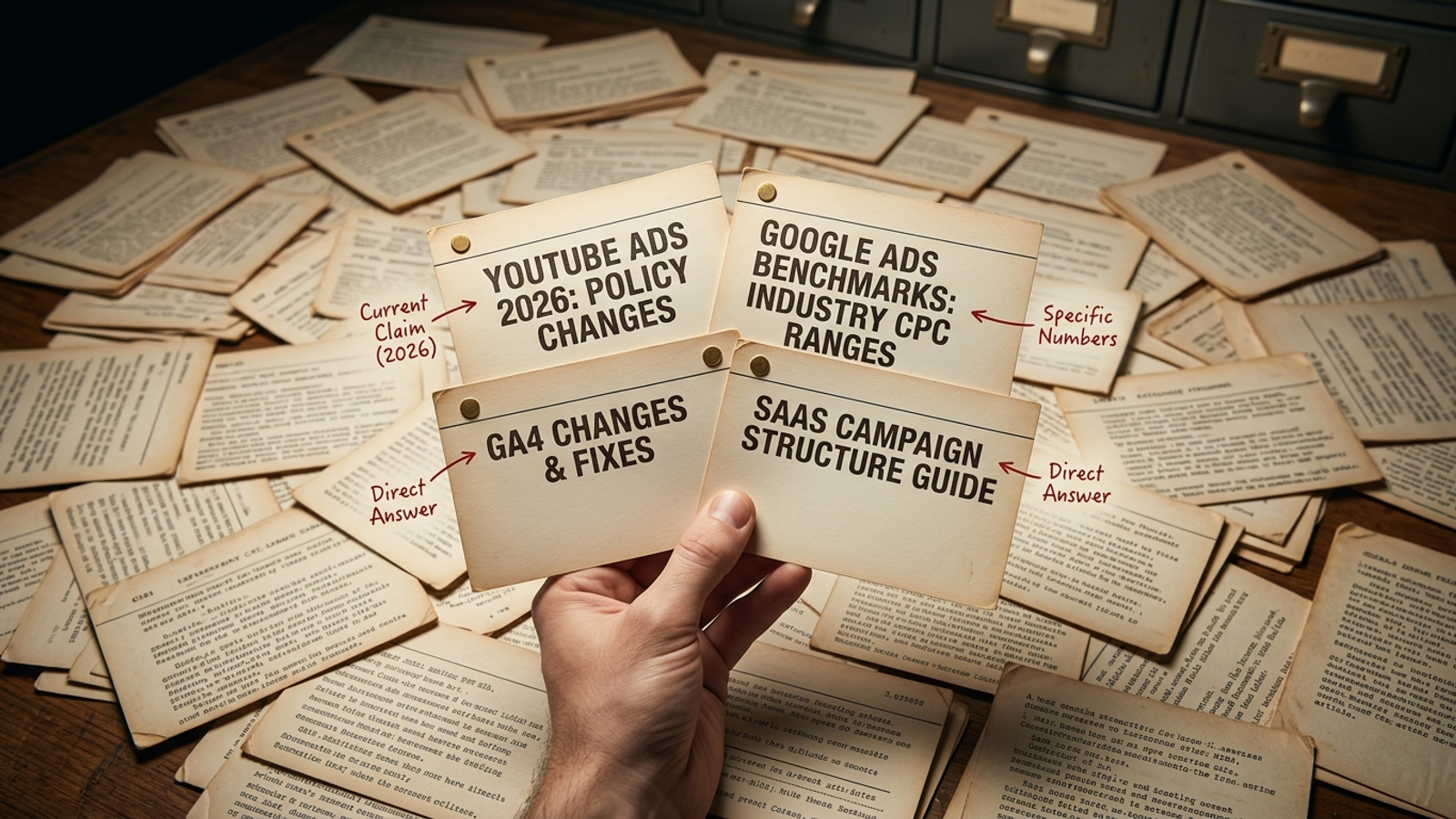
[TRANSLATION: He has named four deliverables without naming the buyer question any one of them answers. Here is the mechanism his slide skips. A page has a better shot at being used for a specific question when the answer is clear and readable, the business facts are consistent, and independent mentions help confirm them. Thirty directory listings do not, by themselves, make the relevant service page answer that question. Neither do two posts whose brief says “thought leadership.” Start with the page that matches the prompt. Make it readable without JavaScript, put the answer in plain language, and look for genuine third-party support. If he cannot connect a deliverable to a question, ask why it is on the invoice.]
REP: Of course, it is never one page in isolation. Authority compounds.
YOU: Then tell me which page you would start with.
REP: Our analysts determine that during onboarding.
YOU: You already ran the audit.
REP: The audit identifies the opportunity. Onboarding develops the roadmap.
[TRANSLATION: The opportunity has a red X beside it. The roadmap is still a noun. I am not against a baseline; I run prompt checks myself. If you do not know which questions produce answers that skip your brand, you cannot choose a page to fix first. But the next step should be a page, not another slide about the existence of pages.]
Act 3: The $4,000 retainer buys five edits and a monthly call
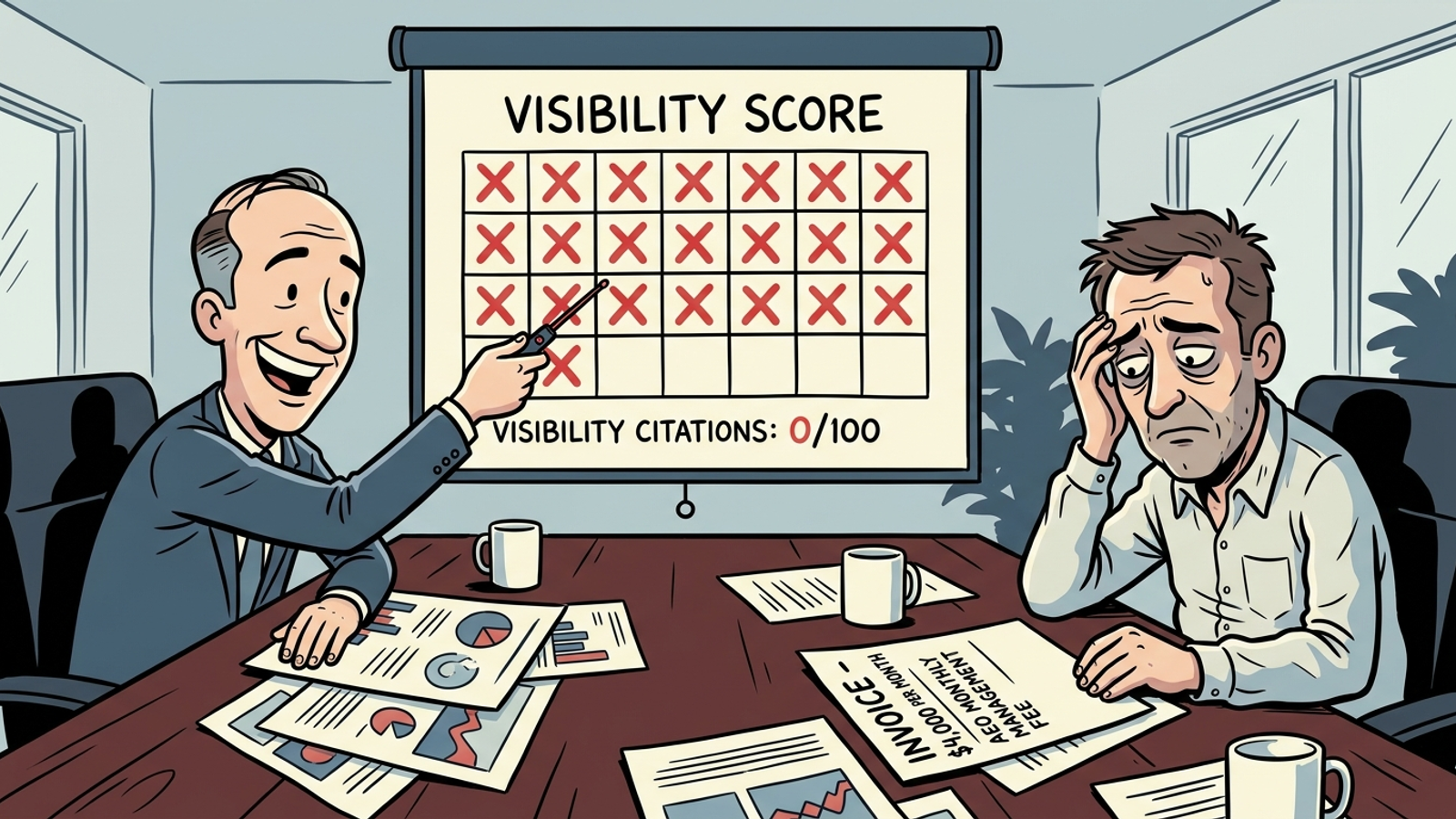
REP: For monitoring, execution and monthly reporting, the investment is $4,000 a month. Twelve-month term, because AI trust builds over time. We include up to five content optimizations per month and one strategy call.
YOU: Five optimizations. What does one look like?
REP: Our analysts review your top prompts, update meta and FAQ copy, submit to our citation network, and log everything in your dashboard so you see the work.
YOU: Does an optimization include rewriting the service page that matches a prompt?
REP: It depends on what the data tells us.
YOU: Does it include fixing the business information on that page if it conflicts with what is listed elsewhere?
REP: We would flag that for the roadmap.
[TRANSLATION: Four grand buys the dashboard, up to five page tweaks a month, and a place to watch someone log them. “Up to” does a great deal of work in that sentence. The prompt count runs into the hundreds because counting is cheap. The promised edits fit on one hand. I have managed PPC accounts with a weekly review while competitors changed bids between reviews. A schedule can describe the work neatly and still be too slow for the account.]
YOU: If our visibility score drops in month four, what happens?
REP: You will see it immediately in the portal. Your strategist will walk through the movement on the monthly call and prioritize next month’s five optimizations around the prompts that moved most.
YOU: I mean, do you fix it that week? Rewrite the matching page, correct the facts, add the missing structured data?
REP: We would assess the source of the movement before making changes.
YOU: Fair. Who assesses it, and when?
REP: Your strategist covers it on the monthly call.
[TRANSLATION: The portal updates. The call explains the portal. Next month’s five tweaks may chase this month’s drop. Sometimes a citation changes for reasons outside your page, so no honest operator can promise to restore it by Friday. But someone can check the answer, inspect the page and decide whether there is something concrete to change. An alert without a timely decision is just a faster report.]
YOU: Can we go month to month until we see a citation move?
REP: We require twelve months because authority compounds. Months one to three are foundation. Months four to six are acceleration. Most clients see visibility lift in month seven. Also, the onboarding fee is waived if you sign today.
YOU: Let me make sure I have this right. I pay $48,000 this year. You track 500 prompts, you edit up to five pages a month, and if the score drops, we talk about it on the monthly call.
REP: Plus the citation network and knowledge graph work. And you get full transparency. Every check, every score, every mention, logged in one place. Most clients tell us the reporting alone is worth it.
YOU: Can you show me a changed page from last month? The before and after, the buyer question it was meant to answer, and what happened when you checked again?
REP: I can show you our reporting environment.
[TRANSLATION: The reporting is the product. The twelve-month term makes the gap between work and outcome harder to pin down. That does not mean every page change earns a citation; it means the sales call should be able to distinguish a page change from a prompt check. If the answer to “What did you change?” is a tour of the dashboard, you have your answer.]
END OF CALL. Prompts promised: 500. Pages changed so far: zero.

The follow-up: your visibility gap is still available
REP (next morning, subject line: Your visibility gap): Just floating this to the top of your inbox. Your competitors gained two citations while we spoke. I can hold the waived onboarding through Friday. Do you want me to reserve your 500 prompts?
YOU: Before I decide, I want to understand what I would buy. You have shown me which answers omit us. Show me the first page you would change and the question it should answer.
REP: We would map your prompt universe, identify entity gaps and align content to the highest-opportunity themes.
YOU: In plain English.
REP: We would review your content against the prompts.
YOU: Then what?
REP: Make recommendations for optimization.
YOU: Who makes the edits?
REP: Our team can handle the included optimizations.
YOU: Which edits are included if you find a page that needs more than new meta copy and an FAQ?
REP: That would depend on scope.
[TRANSLATION: This is the point where a sales call gets useful. Tracking is not useless. I would pay for a baseline that shows which buyer questions trigger AI Overviews or ChatGPT answers that skip your brand. I would not mistake that baseline for the work of changing the pages those answers can draw from. Monitoring answers, “Did the answer change?” Execution asks, “What can we improve on the matching page, and what happened when we checked again?” The first takes software. The second takes decisions, edits and another check.]
YOU: Let us make it concrete. Pick 10 buyer prompts that could bring pipeline. Check where we stand. For each one we can act on, find the matching page and make sure a reader can tell what we do, who it is for, the price range, the service area and the proof. Fix conflicting business facts elsewhere. Add schema and an FAQ where the page needs them. Find a genuine outside mention. Then check the prompt again. Is that the work in the retainer?
REP: That is broadly consistent with our methodology.
YOU: Is it in the scope?
REP: We would finalize the scope in onboarding.
[TRANSLATION: A method is not a commitment. Nor is a citation after an edit proof that the edit caused it; answers move for more than one reason. But a before-and-after page, a named buyer question and a follow-up check give you something to examine. A list of 500 checked prompts gives you something to scroll. Ask for the log of changed pages, not just the log of checked prompts.]
REP: I do not want us to get lost in the weeds. You will have one portal for full visibility.
YOU: I am happy to pay for the portal as a utility. What I will not do is pay an execution retainer without knowing what gets changed.
REP: There is a reason we bundle them.
YOU: There is a reason I am separating them.
[TRANSLATION: Monitoring has a job. It helps you choose where to look and tells you when to look again. It stops earning an execution fee when the response to every finding is another meeting about the finding. Five edits a month across a site with 40 buyer questions may be triage, not coverage. The same distinction matters in paid search, where I have written about what Google Ads agency retainers actually cost. A fee should follow the work being done, not the number of things a dashboard can count.]
YOU: Two final questions. First: show me one page you changed last month, the exact prompt it targeted, and the before and after. Second: if a citation drops on a Tuesday, who checks it that week and who makes any needed change? A person or a model is fine. “Next month’s call” is not a name.
REP: I can arrange a deeper platform demo.
YOU: That answers both questions.
[TRANSLATION: This test will not flatter everyone, including agencies doing real work. If you have three pages, no reviews and no outside mentions, nobody should promise that a retainer will fix your visibility in 30 days. The point is not to demand a citation on schedule. It is to find out whether the seller will do anything more than measure its absence.]
REP: I will keep the waived onboarding open through Friday.
YOU: Keep the prompts, too.
END OF TRANSCRIPT. Total dashboards offered: one. Total pages named for editing: zero.
I pay for monitoring to see what happened; I pay for execution only when someone can show me what they changed.