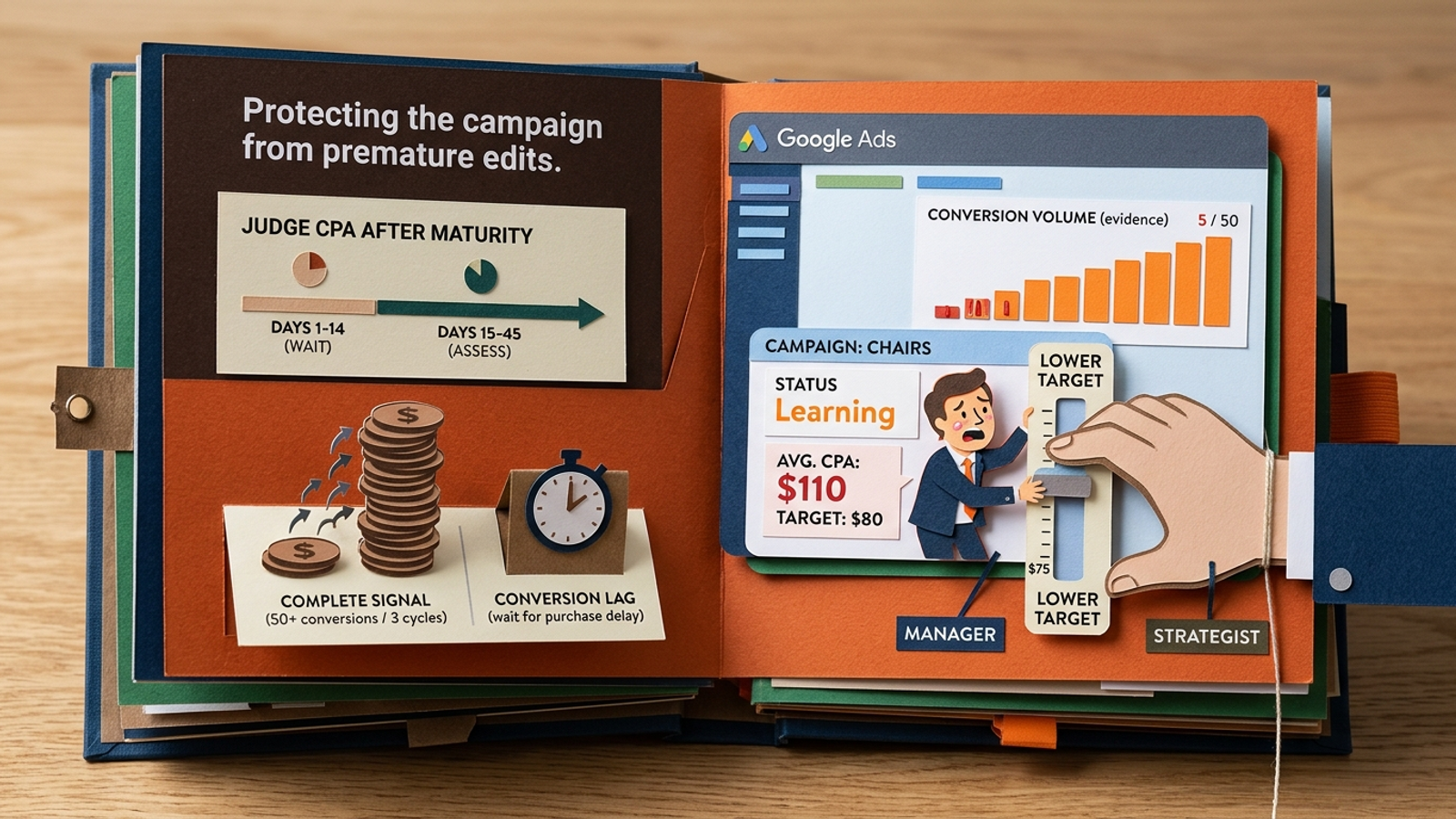
A campaign can look broken on day four and still be doing exactly what it needs to do. The expensive mistake is lowering your Target CPA, cutting keywords, and changing the budget before its conversions have had time to arrive.
I understand the impulse. You switch a campaign to Target CPA, see acquisition cost running at three times the target, and find Learning in the bid strategy status column. The dashboard is asking for your attention, and changing a setting feels more responsible than watching it. But an edit can change the auction pool or bidding objective just as the system is gathering evidence about both. Then you have to judge a campaign whose conditions you keep changing.
The learning phase is about conversion signal, not a fixed number of calendar days. Google advises allowing approximately 50 conversion events or three full conversion cycles before drawing conclusions about Smart Bidding performance. That is a useful guide, not a promise that conversion number 50 flips a switch. An account producing five conversions a week will not become well calibrated merely because two weeks have passed.
So the job is neither to abandon the campaign nor to optimise it every morning. It is to know which inputs need protection, which edits can disrupt learning, and when the numbers justify a change. Here is the order I use.
What is Google Ads learning from each conversion?
Start with the one fact everything else follows from: a bid model needs outcomes to judge its predictions. Smart Bidding uses auction-time signals, including context such as query, device, location, and time, to estimate how likely a click is to produce the conversion you have asked it to pursue. A click gives it some information. A conversion tells it much more about whether that traffic was worth buying.
Say you sell a $350 ergonomic desk chair and want to acquire a customer for $70. The bidder sees auctions for searches with different wording, devices, and contexts. When clicks turn into chair sales, it gains evidence about which combinations merit stronger bids. When similar clicks repeatedly fail to convert, it has reason to value those auctions less. It is not reading your account like an analyst with a coffee and a spreadsheet. It is adjusting estimates from observed results.
Now give that chair campaign a $140 daily budget and suppose it produces two sales a day. After 14 days, it has 28 conversions to learn from. Give the same campaign a $35 daily budget and suppose it produces one sale every three days: after 14 days, it has fewer than five. Both have been live for two weeks. They have not supplied the bidder with the same amount of evidence.
That is why I look at conversion volume before elapsed time. The example is not a budget prescription; changing the budget will not make sales appear on schedule. It shows why a calendar-only rule tells you so little about whether the campaign is ready to judge.
How long should I wait before judging CPA?
First, check how long your customers take to convert. Conversion lag makes recent CPA look worse than a mature cohort’s CPA. The ad click happens today; the purchase, booked call, or other tracked action may happen days later. Spend appears before all the conversions attributable to that spend do.
For a straightforward purchase, that gap might be a day or two. For a longer-consideration offer, someone might click on Tuesday, compare options over the weekend, and convert nine days later. If you assess that second campaign on day ten, you have recorded the spend from ten days of clicks but only some of their eventual conversions. Lowering the target because today’s CPA looks alarming may be a response to incomplete data.

The chair campaign gives you a practical way to think about this. If most chair buyers convert quickly, its first two weeks may tell you something useful, provided it has enough sales. If buyers commonly return after several days, the same reporting window is less mature. Ask both how many conversions you have and how many clicks are still waiting for their chance to convert.
That is the point of Google’s guidance about roughly 50 conversions or three full conversion cycles. It steers you away from declaring victory or failure on a handful of recent outcomes. Our account of what happens in the first 2–4 weeks of a campaign covers the early swings in more detail. For this decision, the useful move is simpler: inspect conversion lag before treating a young CPA as final.
Which changes can send the campaign back into learning?
Google may show a learning reason such as New strategy, Setting change, or Composition change. The label tells you that something about the bidding setup has changed. It does not mean every small edit erases all past knowledge or restarts a literal clock from zero. I would stop thinking of learning as a stopwatch and start thinking of it as a model adapting to the conditions you give it.
These are the changes I would question first, in the order I most want an account manager to notice them:
- A sharp change to Target CPA or Target ROAS. If day four shows a $110 CPA against an $80 target, lowering the target to $75 does not force cheaper conversions into existence. It changes what auctions the bidder is willing to enter while the original traffic is still being assessed. If a target change is warranted, I would make a smaller move, around 10% to 15%, then give it time rather than repeatedly steering by this week’s CPA.
- A budget spike or slash. Doubling the chair campaign’s daily budget after one good Monday does not double Tuesday’s sales. Cutting it hard after a slow weekend can restrict the traffic from which the bidder learns. Neither change is automatically wrong. Both make the next few days harder to compare with the last few days, particularly when conversion lag is still working through the reports.
- Heavy keyword, negative, or asset churn. Pausing a keyword responsible for a large share of impressions changes the auctions available to the campaign. So does a sweeping set of negatives. Removing obvious junk traffic is still sensible; pruning viable traffic every 48 hours because it has not converted yet is a different decision.
- Changing the conversion goal or its value. Switching which action counts as primary, changing how values are passed, or otherwise redefining success changes what the bidder is trying to achieve. This deserves more scrutiny than an ordinary tidy-up. If the tracking is wrong, fix it. If the tracking is right, do not redefine the goal to make an ugly early report look better.
Notice what this list is not: a set of magic percentage thresholds at which Google always resets. The practical test is whether an edit changes the objective, the available auctions, or the amount of traffic enough that the bidder must adapt. Before touching a setting, name the problem it solves and the evidence that problem is real. “The dashboard looks nervous” is not evidence.
There is a commercial wrinkle here. A traditional agency charging a monthly retainer can feel pressure to produce a busy changelog. Twelve edits on Friday look like twelve units of work. In a learning campaign, some of those edits may be the reason Monday’s numbers are hard to interpret. I am not against account management. I am against paying for activity that makes the account less legible.
Does the Learning badge mean performance is settled when it disappears?
No. Bid strategy status and data maturity answer different questions. The Learning badge describes the strategy’s current status after a launch or a relevant change. It is not a certificate that your CPA has reached its long-run level when the badge disappears.
Google also discusses a learning period in the context of evaluating Smart Bidding performance. That is the measurement question: have you allowed enough conversion volume and delay to understand the results? A campaign can stop displaying Learning while its newest clicks have not finished converting. Conversely, a continuing learning status is a reason to investigate the inputs, not proof that the campaign is doomed.
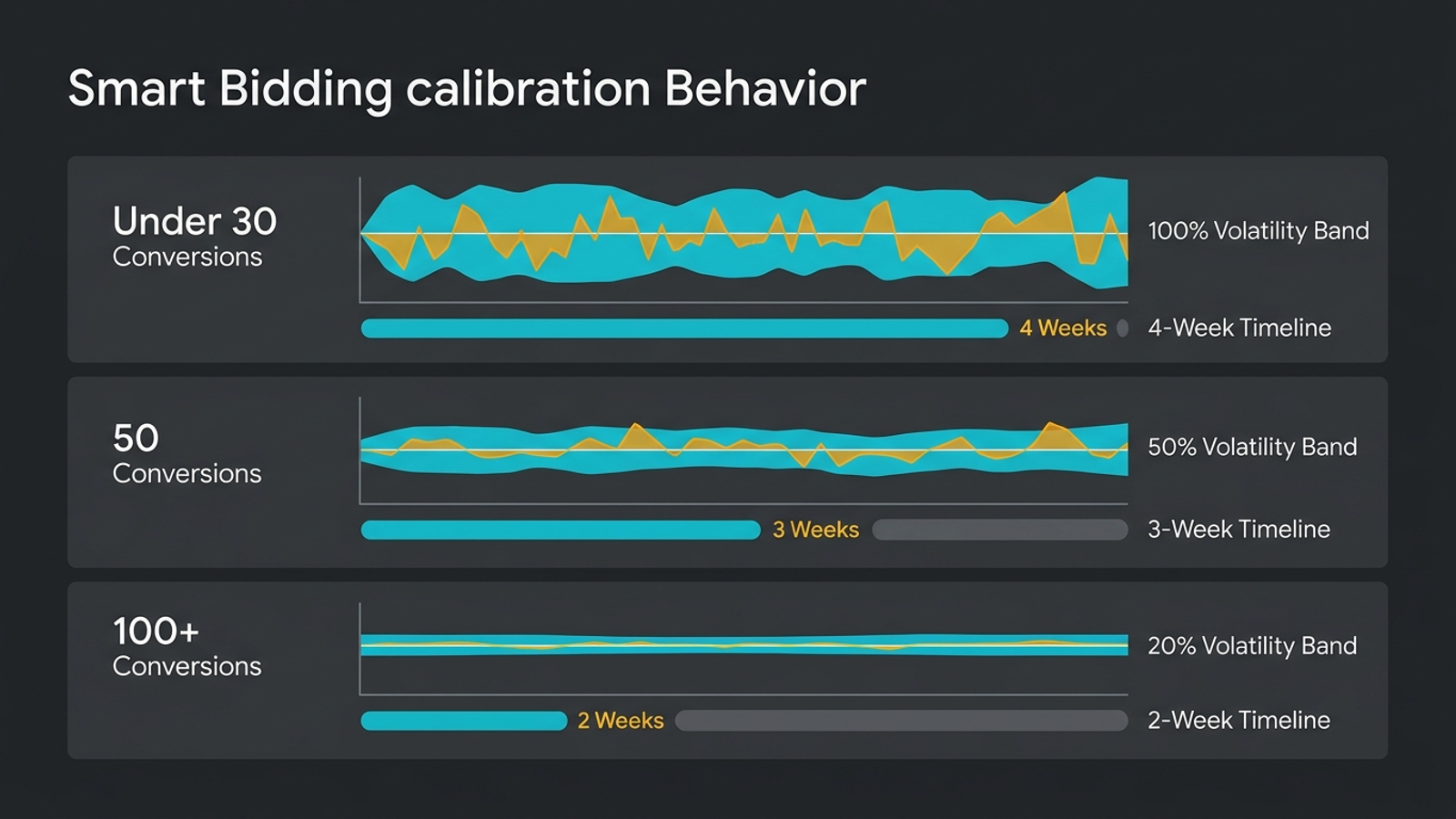
For the chair campaign, I would not schedule a verdict for the morning the badge goes away. I would compare a period with enough sales to say something useful and account for the lag on its most recent clicks. Use the status as a diagnostic prompt, not a graduation date.
What if the campaign never gathers enough conversions?
Sometimes leaving it alone is not enough. A campaign that produces only a few conversions a month may have too little outcome data for Smart Bidding to learn quickly. If impressions shrink and CPA remains high, waiting another week does not solve the underlying shortage. You need to change how the system gets signal.
Work through these options in order of what your account can support:
- Check whether you have split the signal too thinly. If four narrow campaigns serve similar traffic, consider consolidating them or using a portfolio bid strategy where the setup makes sense. Combining related bidding decisions can give the strategy more shared conversion data. Do not merge campaigns with genuinely different goals merely to make a status label disappear.
- Consider an earlier, trustworthy conversion action. A B2B SaaS campaign optimising only for closed-won deals that take six weeks and happen ten times a quarter has a long wait between usable outcomes. A qualified demo request or verified pipeline milestone may provide a more frequent signal. The word qualified matters: replacing scarce good conversions with plentiful junk gives the bidder a clearer instruction to find the wrong people.
- Reduce needless manual churn. In complex accounts, a weekly round of reactive target, budget, and keyword changes can keep moving the conditions under which performance is measured. An autonomous growth engine like groas monitors campaigns continuously, executes within strategic guardrails, and keeps a human strategist accountable for direction. That does not manufacture conversion volume. It can help replace periodic panic edits with more consistent execution while you address the signal problem itself.
For the chair retailer, consolidation might be worth examining if the same kind of customer is scattered across several thin campaigns. It would not fix a broken purchase tag or an offer that does not convert. Fix the shortage you actually have, not the badge you dislike.
What should I leave alone in the first two weeks, and what should I fix now?
Protecting learning is not permission to let broken plumbing spend money. Leave a valid bidding objective alone; fix bad inputs and obvious waste. In the first 14 days of a new campaign or a substantially changed bid strategy, I separate those decisions explicitly.
Leave alone while evidence accumulates:
- Target CPA or Target ROAS changes driven only by a few days of volatile results.
- Budget changes made because one day looked brilliant or one weekend looked terrible, unless there is a real spending constraint.
- Ad-variant judgments based on tiny conversion differences, such as two sales for one variant and none for another.
- Keyword pauses based on spend that has not yet given the keyword a fair chance. At an $80 target CPA, I would not call a keyword a failure solely because it spent $60 without a lead. Even two to three times the target CPA without a conversion is a prompt to inspect the traffic and lag, not an automatic rule for every account.
Inspect and fix immediately:
- Conversion tracking. Confirm the intended action fires and that a page reload is not counting one sale twice. The bidder cannot learn the right lesson from the wrong outcome.
- Clear intent leaks. Review search queries for unmistakably irrelevant traffic and add appropriate negatives. Removing junk is different from excluding a large chunk of relevant auctions because early CPA looks bad.
- Conversion lag. Check how recent clicks mature in the attribution reports before reading their current CPA as the final answer.
- Actual budget limits. If spend is being exhausted before the campaign can serve the traffic you intended to reach, investigate that constraint. Do not change the budget merely to make the graph less uncomfortable.
Here is the judgment call the dashboard will not make for you. Suppose the chair campaign reaches day four with a CPA above $70, a working purchase tag, relevant queries, and buyers who often take several days to return. I leave the target alone and wait for the click cohort to mature. Suppose instead the purchase event fires twice per order or the query report is full of people looking for something the retailer does not sell. I fix that today. The first case has incomplete evidence. The second has bad evidence.
Do that check before your next adjustment: verify the conversion action, look at the queries, and check the lag. If those inputs hold up, close the target-setting drawer and let the campaign collect outcomes. You can make a better decision when you are no longer changing the question every week.