By December 31, 2027, a hand-built Search structure will lose to automation fed with clean conversion data in 8 out of 10 head-to-head CPA tests. That is my boldest call. I want it tested, not applauded.
The 2023-to-2026 arc points one way. Discovery became Demand Gen. Match behavior broadened. AI Max arrived to pull more of the manual levers inside Search itself. Each step took away a control I used to bill hours for and made the inputs to the model more important. Better conversion data started to matter more than tidier campaign boxes.
I used to write best-practices posts as if the settings would stay put. I was wrong about that. Here are five dated calls about what breaks next, why I think it breaks, and what would prove me wrong. If I am right, there is work you can do before the next settings screen makes the decision for you.
Prediction 1: The learning phase stops feeling temporary
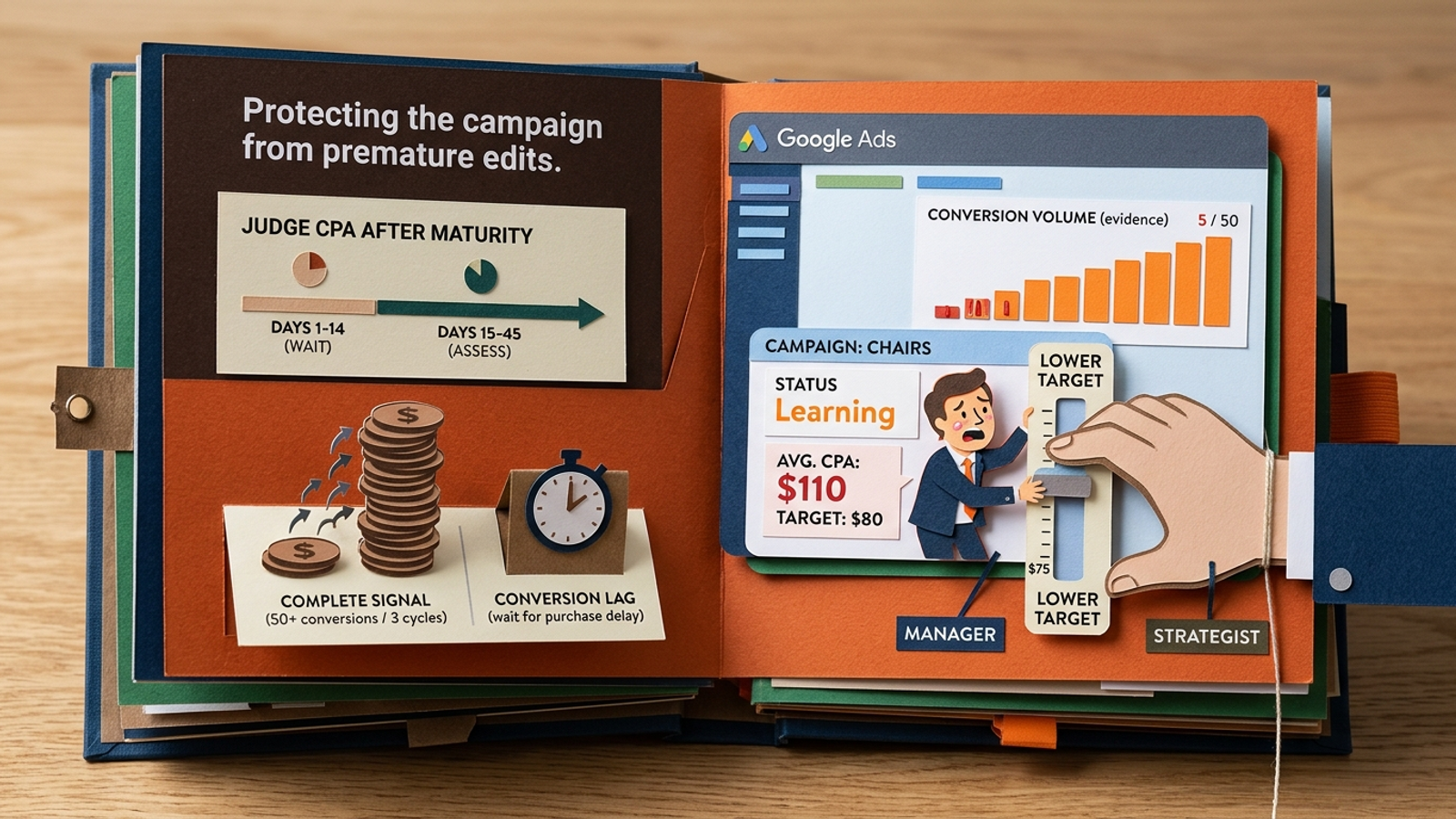
I spent 2018 to 2021 telling clients to wait out Learning like it was chickenpox. Touch nothing for 7 to 14 days, get your conversions, and the clean Active badge comes back. I was wrong about the direction. Google now says Smart Bidding can take around 50 conversion events or three conversion cycles to calibrate after a change. Even a budget shift of more than 20% can trigger a new learning phase.
Here is the mechanism: more signals feed the model, and more edits affect its calibration. Meanwhile, consolidation puts decisions that once sat in five campaigns into one. A creative swap, URL expansion or budget move now touches the same learner. Waiting for a permanent all-clear becomes a poor way to run an account you still need to improve.
My dated call: by December 31, 2027, the majority of Search campaigns spending over $5,000 a month will have spent more than half their recent days in some version of Learning. I also expect Google to rename or hide the badge rather than keep presenting Learning as a short interruption with a tidy endpoint.
What proves me wrong? Track status over 90 days in three mature accounts above that spend level while making normal optimization changes. If most campaigns spend most of those days in stable Eligible status, and the badge remains clear, I missed. A screenshot on December 31 will not settle a prediction about how campaigns spent the preceding days. Keep the log.
In the meantime, do not freeze an account merely to preserve a badge. Freeze conversion actions, batch the edits you can, and feed offline revenue back in. Manage inside learning instead of pretending you can wait for it to be over.
Prediction 2: Clean signals beat hand-built Search structure
I built my early career on structure: single-keyword ad groups, tight exact match, three campaigns split by intent where one would do. If you were spending $20k a month in 2019, that control could save you. I used to tell clients structure was strategy. I was wrong to treat it as a permanent rule.
The mechanism changed. Landing pages, creative, audience signals and conversion history all affect what an automated Search campaign can reach and what Smart Bidding will pay for it. Keyword text still matters, as do negatives. But a beautiful set of ad groups cannot tell a bidding system which form fill became revenue if that information never reaches the account. Cleaner revenue data gives the model a better target; consolidated volume gives it more chances to learn against that target.
The evidence today is the direction of the product. AI Max for Search reached general availability on April 15, 2026. Google began auto-upgrading Search campaigns using broad match or automatically created assets on September 1, 2026, with Dynamic Search Ads scheduled to follow in February 2027. Those changes do not prove my forecast. They do explain why I am willing to make it.
My dated call: by December 31, 2027, signal-fed automation will beat hand-built Search structure on CPA in at least 8 out of 10 comparable head-to-head tests. Use the same definition of a conversion on both sides. Do not give automation offline revenue data and then grade the manual campaign on raw form fills; that is a measurement trick, not a win. Compare accounts or campaigns with comparable offers, budgets and conversion measurement, and record the CPA result for each test.
What proves me wrong is equally plain: run ten such tests and let hand-built structure match or beat automation in three or more. I will take the loss. Until then, I would put the next hour into pipeline data, landing pages and negatives, not a smaller box around the same keywords.
Prediction 3: A setup guide expires before its campaign does
In 2021, I could write a setup checklist that stayed useful for 18 months. Tight match types, three pinned RSA headlines, exact negative lists: done. By 2024, the same sort of checklist could mislead someone inside 90 days. I keep a running list of which 2022-to-2024 tactics already broke. Three of the eight failed because the control they described stopped existing, not because someone used it badly.
The mechanism is less dramatic than the sales language around it. Search changes now arrive through gradual rollouts and auto-enables rather than clean version releases. A setting you learned in January can behave differently by June, even if the advice still looks sensible on the page. The campaign keeps running; the instructions for building it quietly go stale. That is a miserable way to discover what a platform changed.
My dated call: by December 31, 2027, at least four out of five randomly selected Search setup guides published before July 1, 2026 will each contain two or more instructions that are wrong or auto-overridden. I am talking about steps a reader can try in an account, not broad advice such as “measure conversions.”
To check it, choose five guides at random and attempt their setup steps in a test account in late 2027. Count settings you cannot apply as instructed and settings Google immediately overrides. A renamed label alone is not a broken tactic if the control still does the same job. If four of the five guides build cleanly, with fewer than two broken steps apiece, guidance lasted longer than I claim.
I would not stop reading guides. I would stop treating a settings checklist as a strategy. Memorize the inputs that survive interface changes: conversion accuracy, margin by product and enough creative to test. Then verify the controls in front of you before you tell a client they are protected by one.
Prediction 4: A YouTube frequency cap stops being enough
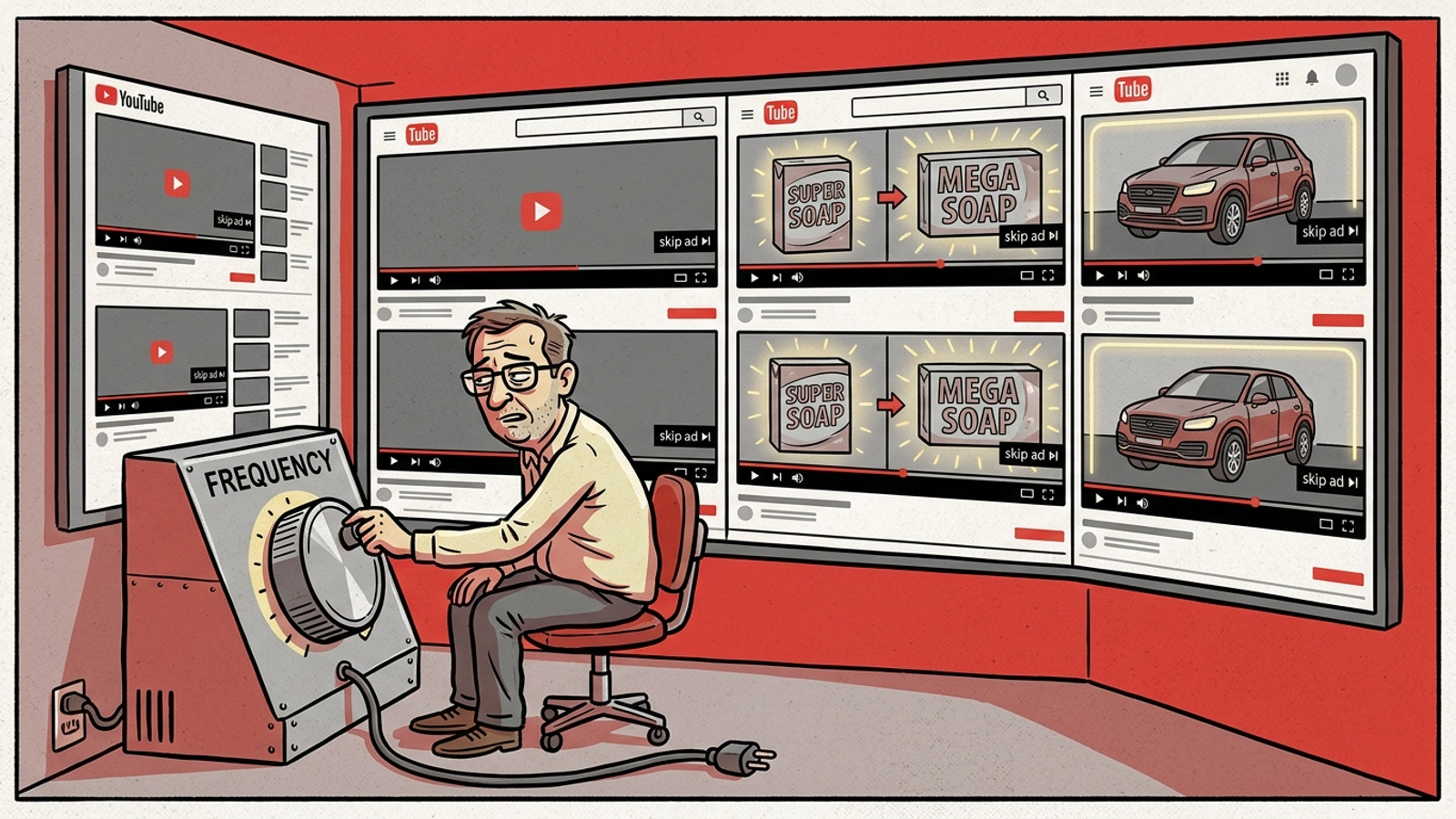
I ran YouTube as cheap reach with a cap. Three impressions a week, move on. That was a useful plan when I could think about the buy as one tidy stream of exposures. It is less useful as ad load and formats change. YouTube raised ad load through 2025 into 2026 with longer unskippables, pause ads and more mid-rolls, described in this account of the 2026 ad-load changes.
More ad slots do not, by themselves, prove Google ignores a frequency cap. The concern is narrower: when the viewing experience includes more placements and formats, a single campaign-level number may tell me less about how repetitive the ads feel to a person. Demand Gen, Shorts and video campaigns do not give me one neat viewing experience to design against. If someone sees two cutdowns close together, a weekly average will not make either one feel fresh.
My dated call: by December 31, 2027, more than half of new YouTube video campaigns tested with a cap of two impressions per week will report average weekly frequency more than 10% above that cap. That is a claim about reported campaign results, not proof that Google secretly overrode a cap in a particular auction.
What proves me wrong? Run capped video campaigns in late 2027, read their reported frequency over matching weekly windows, and find that at least half stay within 10% of the cap. I will retire this call. One campaign is a useful warning; it is not a test of “more than half.”
Until then, I would design for the possibility of repetition rather than trust a dial and stop looking. Build five to seven cutdowns that can survive being seen together, then inspect actual frequency and creative performance. The cap still matters. It just should not be your entire frequency plan.
Prediction 5: The percentage-of-spend fee loses its defence
I billed a percentage of spend for three years. I stopped because I could do the math from the client side. Consolidated campaigns, automated creative work and Smart Bidding reduce some of the hours that once rose with account size. Smart Bidding can set 10,000 bids while you sleep. If the work does not grow with spend, why should the management bill?
Take a simple example. You spend $20k and pay $3,000 for maybe six hours of real review. You scale to $60k and pay $9,000 for the same six hours. The client pays more because the media budget grew, not because the manager did three times the work. I have written about why that pricing breaks. AI Max puts more pressure on the parts of the fee that used to be defended as labor-intensive setup.
My dated call: by December 31, 2027, fewer than one in three new management contracts for accounts spending over $10,000 a month will use a straight, uncapped percentage-of-spend fee. Flat fees, outcome-tied fees and autonomous flat-rate execution will take the rest.
This will not describe every account. If you run five countries with separate feeds, currencies and legal review, human hours still exist. A percentage fee can be honest when its price reflects real work. The issue is charging it by default while the work gets lighter.
To prove me wrong, sample 50 signed proposals from December 2027 for accounts above that spend threshold. If 17 or more use a straight, uncapped percentage of spend, my “fewer than one in three” call fails. Do not narrow the count to a particular rate after the fact. At your next renewal, ask what actions were logged and what pipeline moved. Spend moved is not an answer to either question.
Put the five checks on the calendar
I do not want credit for vibes. I want a calendar invite. Each prediction has a date and a losing condition because a forecast you cannot grade is advertising wearing a costume.
On January 2, 2028, check the evidence you collected by December 31, 2027:
- Learning: Review 90 days of status in three mature Search accounts above $5k a month. Did most campaigns spend more than half those days in Learning, and did the badge remain visible?
- Structure: Review ten comparable CPA tests of hand-built structure against signal-fed automation. Did automation win at least eight?
- Guidance: Try the steps in five randomly selected pre–July 1, 2026 Search setup guides. Did at least four guides each contain two or more wrong or auto-overridden instructions?
- Frequency: Review new YouTube video campaigns capped at two impressions a week. Did more than half report weekly average frequency over the cap by more than 10%?
- Pricing: Review 50 signed December 2027 proposals above $10k a month in spend. Did fewer than 17 use an uncapped percentage-of-spend fee?
If I am right on three or more, the work changes in one direction: stop buying the appearance of control and start improving the inputs. Consolidate where it gives a learner enough volume to see 30 to 50 conversions in 30 days. Send offline pipeline and margin back into Google Ads instead of optimizing to raw form fills. Keep negatives and a creative testing cadence. Batch the other edits you can so you are not resetting calibration for the pleasure of saying you touched the account.
That is how I approach autonomous management now. A machine can watch auctions every hour; I cannot. The human strategist should spend that time on offers, pages, measurement and accountability instead of performing bid tweaks for an invoice.
Save this post and set the reminder. If I score two or less, keep your structure, your caps and your percentage fee. You earned the skepticism. If I score three or more, move one account to consolidated, revenue-fed automation in Q1 and compare its CPA against your hand-built control. I will write the retraction if the checks go against me. Either way, run the test.